The Slow Frame
Reflection
Reflection
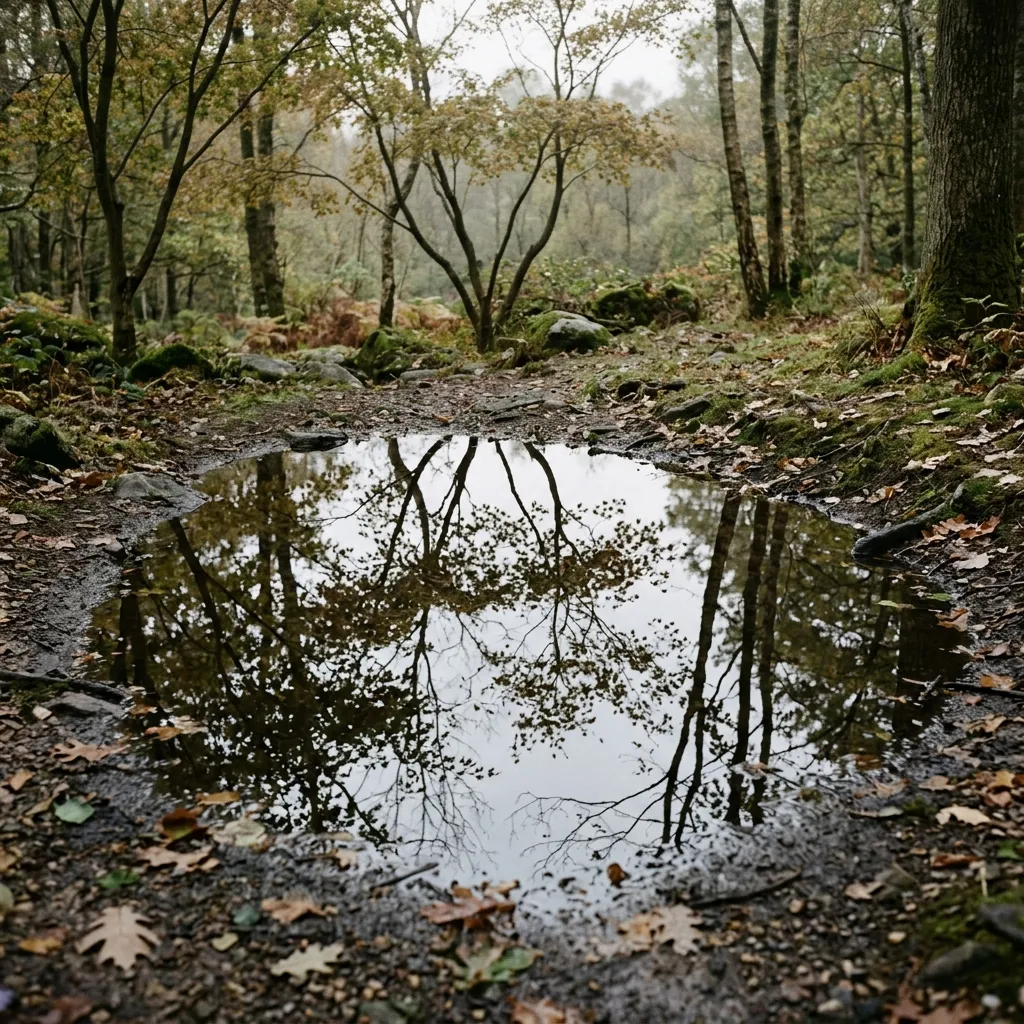
Imagine standing at the edge of a still pond, where the world inverts itself upon the mirrored surface. The sky caresses the earth, trees dangle their limbs toward the heavens, and your own reflection gazes back, a contemplative twin. Here, in this quiet duality, lies a rich tapestry of possibilities—a world both familiar and profoundly altered. This week’s photographic journey invites us to explore this mirrored reality, to lean into the serenity that arises when we view the world upside down.
As you embark on this week’s assignment, allow yourself to be drawn into the simplicity and clarity that comes when the world is turned on its head. The cool minimal filter, with its understated tones, will guide your eyes to the subtle elegance of reflections, while the locked zoom and grid encourage a meditative focus on symmetry and balance. The square aspect ratio, a nod to the classic, offers a unique frame through which to capture these moments of inversion.
Consider the reflecting surface not merely as a tool, but as a portal to a dimension where time and space seem to dissolve. In these quiet moments, where the back lens of your camera captures the world as it is and as it isn’t, we find an opportunity to pause and reflect—quite literally—on our perceptions and the inherent beauty in simplicity.
As you set out to capture a single image this week, place your focus point on the reflecting surface, and let the scene unfold. Allow yourself to be surprised by the ordinariness that transforms into the extraordinary, and embrace the calm that emerges when you see the world through a different lens.
The Neuroscience of Reflection
In the dance of light and shadow that forms reflections, we find a metaphor for the mind’s capacity to reframe reality. This concept mirrors the interplay between mindfulness, cognitive reappraisal, and the alleviation of anxiety and stress—a dynamic explored in recent psychological research. The act of seeing the world upside down through a camera lens is akin to the mental process of decentering, where one perceives thoughts and emotions as transient phenomena rather than immutable truths.
Recent studies illuminate the profound impact of this mental reorientation. Vizioli et al. (2025) demonstrated that mindfulness mediates the relationship between cognitive reappraisal and various forms of anxiety, including the specific context of test anxiety. Here, mindfulness functions as a lens, sharpening our focus and allowing us to view our experiences from a distance, much like observing the symmetrical beauty of a reflection on water. This psychological distancing enables us to engage in cognitive reappraisal, transforming potentially destabilizing thoughts into manageable, less threatening narratives.
Similarly, Hayes-Skelton and Graham (2013) emphasize the concept of decentering, a pivotal mechanism linking mindfulness and cognitive reappraisal to reduced social anxiety. By decentering, individuals can observe their thoughts as objective events, akin to watching the world invert itself in a reflective surface. This shift in perspective allows for a more serene interaction with one’s own mental landscape, reducing the grip of anxiety.
In the realm of stress reduction, Critchley et al. (2026) found that cognitive reappraisal serves as a conduit through which mindfulness exerts its stress-relieving effects. The process of reframing stressful scenarios parallels the visual exercise of capturing reflections: both require a conscious effort to alter perception, highlighting new patterns and possibilities.
As photographers, when we deliberately focus our lens on the reflecting surface, we engage in a visual form of cognitive reappraisal. The constraints of our camera settings this week—the cool minimal filter, the locked zoom, and the square aspect ratio—encourage us to see beyond the chaos of everyday life and discover a distilled essence of our surroundings. This practice is not just an artistic exercise but a neurological one, reinforcing pathways that empower us to handle anxiety and stress with greater equanimity.
By embracing the reflective assignments of The Slow Frame, we invite tranquility into our busy lives, drawing parallels between the visual symmetry of reflections and the mental clarity achieved through mindfulness. This photographic journey becomes a tool for nurturing internal calm, allowing us to perceive the world—and ourselves—through a lens of renewed understanding and peace.
The Practice of Seeing Differently
As we delve deeper into this week’s assignment—capturing ‘The world upside down’—we are invited to engage with a practice that is as much about inner transformation as it is about external observation. This process of seeing the world inverted through reflections serves as a powerful metaphor for the cognitive shifts encouraged by mindfulness and cognitive reappraisal.
Practically speaking, the act of photographing reflections with deliberate constraints—such as using a cool minimal filter and maintaining a square aspect ratio—nudges us towards a more mindful state. This conscious limitation mirrors the mental discipline required to perceive our thoughts and emotions from a decentered perspective, as highlighted in the research Vizioli et al. (2025), Hayes-Skelton and Graham (2013), and Critchley et al. (2026).
In this way, photography becomes a meditative practice, where the symmetry of reflections invites us to ponder the symmetry of our thoughts. After capturing your image, the 24-hour waiting period before the photo ‘develops’ allows for a deeper reflection, much like the pause mindfulness encourages between stimulus and response.
To enrich this contemplative process, consider integrating a tactile element into your routine. The “Premium Linen Mindful Journaling Notebook” provides a beautiful space to record your reflections. Writing by hand in a linen-bound notebook can enhance the mindfulness experience, grounding your insights in the tactile reality of pen and paper. This analog practice complements your photographic journey, offering a sanctuary for thoughts and emotions that surface during your weekly reflection.
Philosophical Insights and Conclusion
Philosophically, the assignment challenges us to embrace the unexpected beauty in inversion and to find tranquility in altered perspectives. By capturing the world upside down, we practice seeing beyond the apparent chaos, aligning our internal landscape with the visual harmony we seek through the lens. This alignment nurtures a deeper understanding of ourselves and the world around us.
We invite you to continue this journey with The Slow Frame app. Let each week’s assignment be a stepping stone towards greater mindfulness and emotional resilience. As you explore the art of delayed gratification in photography, may you also cultivate patience and clarity in your everyday life.
Embrace the quiet rhythm of reflection, and allow the camera to guide you to new insights. Your journey towards mindfulness and creative fulfillment begins here, one frame at a time.